There’s more going on than meets the eye.
FILM
A video is just a series of photos.
Film a student side-on with the iPad. Every frame becomes something we can measure.

COMPUTER VISION
It finds the student in every frame.
A model trained on hundreds of thousands of images locates the body. No markers. No wearables.

POSE ESTIMATION
33 points, head to toe.
Connect the points and you have a digital skeleton, tracked frame by frame.

GRADING ALGORITHMS
Measured, benchmarked, saved.
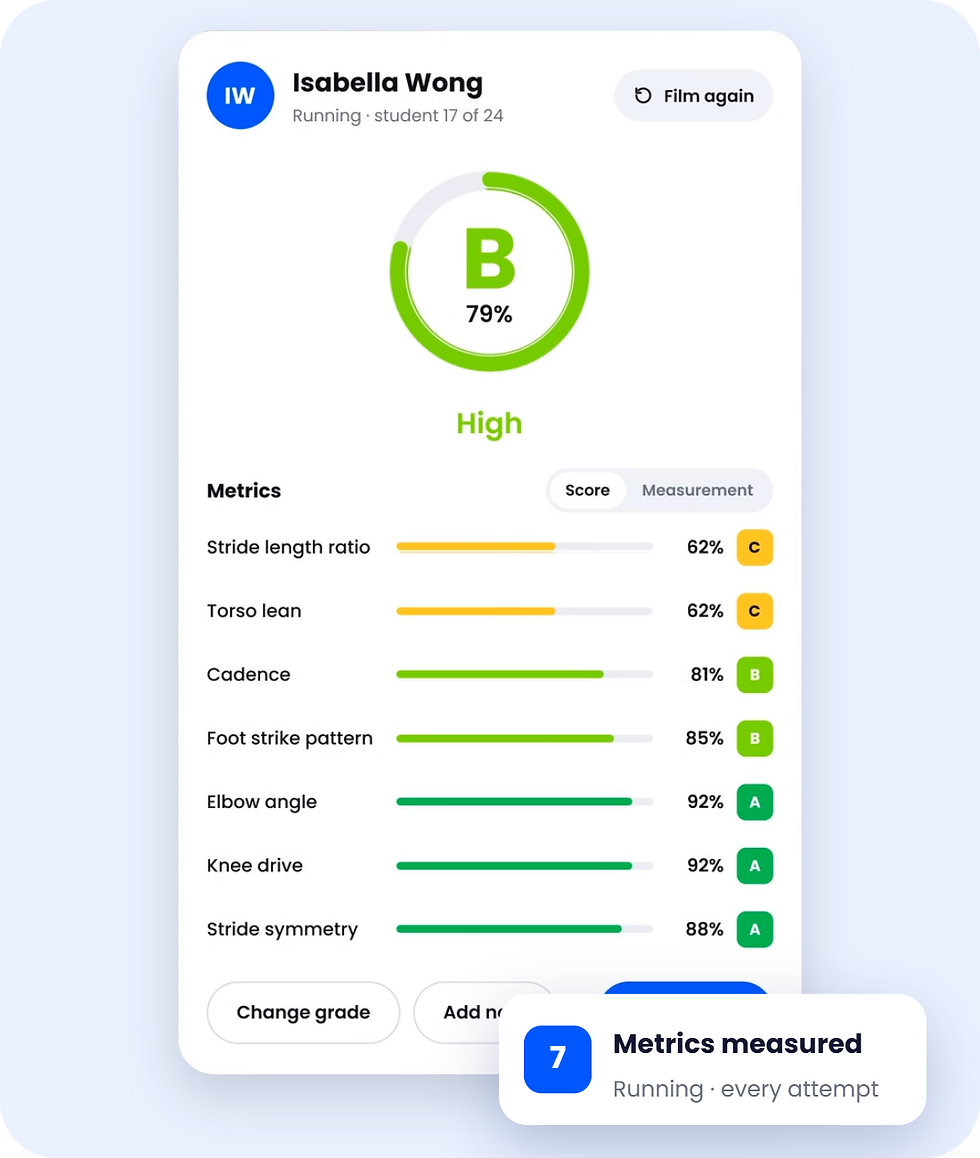
Every metric is checked against benchmarks for the student’s year band, then the grade saves to your gradebook.

Not so long ago, this took a biomechanics lab, reflective markers and a serious budget. Today it runs on the iPad in your hands.
HOW SKILL GRADER WORKS


OUR STORY
A problem in plain sight.
After graduating from Murdoch University with a Bachelor of Education in 2018, I taught in a range of primary schools and became fascinated by how movement skills were assessed around the world. The more I researched, the more one question bothered me: how can a motor skill be assessed fairly & consistently, based on one person’s interpretation?
Without the right tools, judging a physical performance by eye is highly subjective. Two teachers can watch the same sprint, give different grades, and neither can prove which one is right.
The research supported my doubts. Visual observation is open to unconscious bias, many teachers feel underprepared to assess motor skills, and a lack of class time is the barrier they mention most. Yet no matter who I spoke to, nobody seemed to be talking about it.
Inspired by the idea that every student deserves a fair and consistent grade, I went looking for a better way. I found it in computer vision, the type of technology sports scientists use to measure movement objectively.
The technology to measure movement already existed, but it lived in biomechanics labs. So, we built Huddl to democratise movement science & put this technology in the hands of teachers.

Timothy Starkey
Founder & CEO, PE teacher
UNDER THE HOOD
The science behind every grade.

KINEMATIC DATA
Measured, not guessed
Angles, timings, symmetries, ranges, ratios... you name it.

FAIR FOR EVERY BODY
Built for different sizes
Measurements are purposefully designed not to penalise students for different body sizes or limb lengths.

YEAR-BAND BENCHMARKS
Informed by published research
Five year bands, Pre-primary to Year 10, so every student is compared with what’s expected for their age.

CURRICULUM
Mapped to your curriculum
Every skill can be mapped to your own curriculum.
RESEARCH PARTNER
Tested against the lab.
We’re partnering with Flinders University on a validation study comparing Huddl with Vicon motion capture, the gold standard in biomechanics labs.
Flinders
University research partner
Vicon
Lab motion capture benchmark


WHY HUDDL
Pushing what’s possible
in PE.
Sport science has moved fast. Motion capture, machine learning and computer vision now measure movement in ways that weren’t possible a decade ago. PE assessment hasn’t kept up.
Huddl exists to close that gap. We build on published research, test our models against the lab and keep pushing what a single iPad can measure, so the future of PE is driven by evidence.
THE TEAM
Teacher-built. Tech-led.

Timothy Starkey
Founder & CEO, PE teacher

Gowrab Bhowmick
Co-founder & CTO
WHAT WE STAND FOR
Three things we won’t compromise on.

Students come first
Every child deserves to feel safe being assessed. Footage is processed on the iPad and deleted, there’s no facial recognition, and their data belongs to their school. Never sold, never shared.

Every student included
Big or small, sporty or not, with or without disability. Every student gets a fair go and a clear next step.

Evidence over opinion
Every grade comes with the data behind it. If we can’t back something up, we won’t claim it.

Built for real lessons, not the lab.
Thirty kids, one iPad and a single lesson. That’s what Huddl is designed for.
